


Hello everyone.
We are "koko no me," a media platform operated by Creative Studio koko.
We create spaces where those involved in "creating" and "delivering" can explore paths toward a better society and workplace—areas where we can engage in expression, project planning, and communication, and empower one another.
Our theme is "What we want to talk about right now." We aim to connect with new perspectives by first bringing up topics that we ourselves, as creative professionals, are curious about regarding the creative production process, ways of working, and how we interact with society, and by engaging with different knowledge and modes of thought.
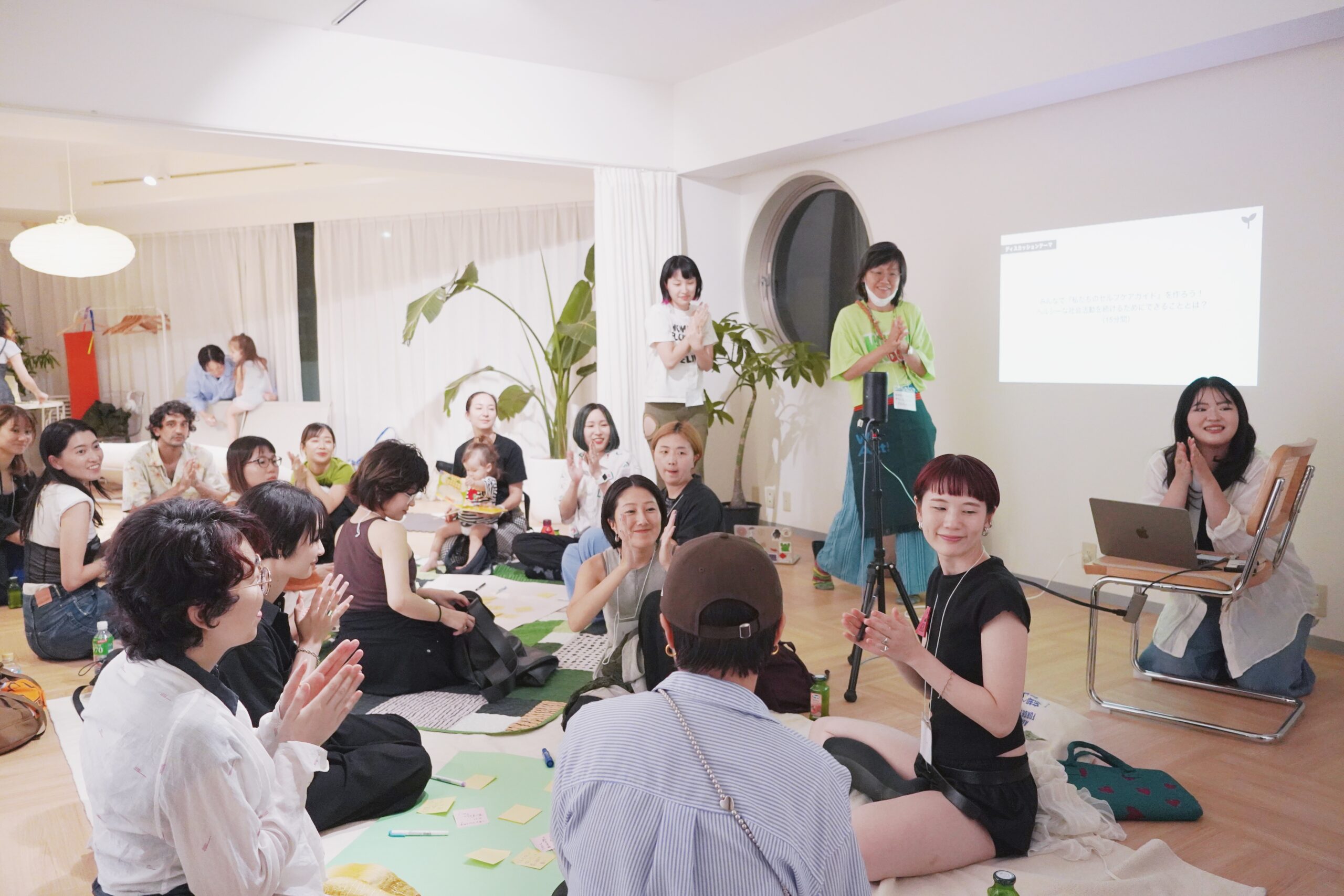
In this article, we share a report on the event "Politics We Need to Think About After the Election: Our Action Meeting," held on August 1, 2025, where we reflected on the results of the July 20th House of Councillors election and explored what we can do moving forward.
This election was marked by rhetoric that fueled social division.
It felt like a campaign where personal dignity and our right to live with peace of mind were increasingly threatened.
Additionally, the low voter turnout, particularly among the youth, is a topic that surfaces every election. On social media, we frequently see comments like, "What will one vote change?" or "I don't feel like my voice is heard."
Facing such realities, it may be natural to feel as though your voice or position is insignificant, or that there is nothing you can do. However, politics is not just for a select few; it is shaped by the voices of each and every one of us.
For our koko no me event held on August 1, 2025, we welcomed Momoko Nojo, Representative Director of the general incorporated association NO YOUTH NO JAPAN, to discuss with participants how we feel now that the election is over and what actions we can take from here on out.
"Raising your voice is by no means easy."
Acknowledging that premise, we re-examined the meaning of having an opinion, taking action, and expressing one's will.
First, we asked Nojo how she views this recent election, focusing on gender equality and the rise of far-right parties. Following that, we explored two perspectives on what we can do to improve politics, even if just a little.

Nojo: In the Diet, elected lawmakers join committees where they engage in detailed discussions on legislation. You could say that committees are the place where the public will expressed in the election is translated into actual policy. That is precisely why, now that the power balance between political parties has shifted significantly, it is crucial to keep a close watch on what is discussed in each committee.
Even if a party has only a small number of members on a committee, they can still advocate that "this law should be changed in this way" through their questions. Such moments are often broadcast on television or covered in the news, drawing public attention. It is important to track how this "agenda setting*" function works. Furthermore, if a lawmaker appears who makes claims not based on facts, it is essential for citizens to serve a monitoring role. We are required to continue watching political movements not just during elections, but in the periods between them.
*Agenda setting: The process by which the volume and frequency of topics taken up by mass media and politicians shape what society considers to be "important issues right now."
Nojo: I feel that rejecting or criticizing people who support a different political party does not change the situation. Of course, it is vital to oppose discrimination and to be able to say in the moment that "this is wrong." However, repeating "NO" will not earn sympathy from people who have remained unmoved by it before. Instead, it is important to present the "YES" options we hope for and expand our circle of empathy.
Even among those who hold opposing views or vote for different parties, many are likely struggling with their own daily hardships while casting their votes with hope. I would like to start by thinking about our own vision of an "easy-to-live-in society" and sharing what we want to communicate in various spaces, so that these people might eventually see our path as a better one.

From the middle of the event, participants split into groups for discussions.
The first theme was "What excited me or bothered me about this election." Looking back on the campaign, participants shared what they felt.
Things that were exciting
・More people discussing the election and sharing information than before.
・Being encouraged by seeing protest activities by people saying NO to discrimination.
・Feeling a sense of increased interest as many people gathered in the streets during the campaign.
Things that were bothersome
・Catchy slogans receiving more attention than the substance of policies.
・Focus being placed solely on "foreign issues" despite the many topics that needed discussion.
・Extreme comments on social media and unreliable reporting standing out.

Based on what was shared, the participants then brainstormed ideas under the theme of "What I can do now," classifying them into things one can do individually, things one can do in cooperation with others, things doable at work, school, or in the community, and other miscellaneous ideas.
Here are some of those suggestions.
Participant A: When opinions differ, I get a bit intimidated. Even though I have things I want to convey, I can't say them in the moment and just end up mumbling. So, I think it would be good if I could organize what I want to say in advance and have it ready as a "package."
Participant B: I'm going back to my parents' house soon, so I want to try asking them, "Which party did you vote for?" I was too scared to do it before, but someone in my group said they were able to talk properly with their family during this election, so I hope I can also discuss with them calmly why they made that choice and what they empathized with.
Also, I thought that through art like movies, one can understand that there are people with different ways of thinking, which can be a bridge to deeper empathy, so our group introduced various movies to each other.
Participant C: A common opinion among us was "Let's just keep talking about it." I think there are things we can do, like supporting candidates on social media, sharing fact-checks, and in our immediate circles. When someone makes a surprising remark, instead of immediately countering them, I want to ask why they thought that way. By finding points of agreement, I think that's important to prevent division. Ultimately, there isn't an immediate answer to what we should do, but I want to continue without despairing, and keep doing what I can without giving up.
Participant D: I sometimes give up on talking because I don't want to ruin my relationship with the other person. That's why I think it's important for me to change myself as well, by learning techniques for dialogue—like the ground rules of this event—and by absorbing information on how to communicate effectively.


While the approaches varied—from social media communication, dialogue with family, to understanding through culture like movies—a common theme was the ingenuity to convey one's thoughts bit by bit while maintaining relationships, rather than creating division through differences in opinion.
Finally, incorporating the ideas from everyone, Nojo provided some closing comments.
What emerged were hints for engaging positively with politics and society in our daily lives.
Along with Nojo's comments, we introduce these 5 TIPS.
Nojo: Looking at the current state of society, it might be difficult to find reasons for optimism unless you actively seek them out. I think it's natural to feel despair at times, such as when discussions on same-sex marriage or selective separate surnames for married couples don't progress as hoped, or regarding the future course of the Diet.
But I think the thing those with opposing opinions hate the most is for us to continue raising our voices without giving up. That is why I feel it is important to keep speaking out and to remain optimistic while doing so.
Nojo: Staying with people who think like you is important, but at the same time, it can lead to a narrow perspective. That's why I think it's important to occasionally step out of your comfort zone and talk to people with different opinions. In those moments, you might find yourself thinking, "How can I persuade them?"
But there are as many different backgrounds, perspectives, and senses of justice as there are people. Everyone has different standards of values. That's why it's important to have the premise that just because you've spoken, the other person won't necessarily change right away. You can't choose the timing for when someone else's heart will open. However, change can sometimes sprout from the gaps that appear while continuing a dialogue.
Nojo: If you talk to someone with different opinions by tying their views to the person themselves, you might end up hurting them in ways you didn't expect. Even if you can't change the person entirely, it is enough to just share your own thoughts by saying, "This is how I feel." When you do that, you find parts where you can empathize, like "We agree on this point," and the conversation naturally expands.
Nojo: If you think in terms of a "me versus society" framework, you might find it painful, wondering, "Why hasn't society changed even though I'm doing so much?" But if you look back on why you started your activism, I'm sure it began because you realized through gaining knowledge that "what happened that time wasn't my fault," or you were able to process past experiences, or felt reassured that "I wasn't the only one." Originally, you likely started this to make your own life a little easier.
When you feel, "Why am I trying so hard?", it might be a sign that you are pushing yourself too far. That is exactly when it's necessary to engage while valuing your own space.
Nojo: There are many things that "I" cannot change alone, but that "we" can change. It is impossible to change the world by yourself, and if you become convinced that "I am the only one," it can actually become quite painful.
That's why it's important to place yourself in environments where you can feel that "I am a part of this," such as by participating in events or getting involved in organizational activities. Because such spaces exist, even when you feel lonely or desperate, you can find the positivity to say, "Let's do this together."


In today's society, individual backgrounds and ways of living have diversified, and "differences" have become the norm.
This event was full of hints on how to face those "differences" in our daily lives, not just in politics.
When you encounter different opinions or positions, you might feel hurt by the other person's words or feel as if you are being denied yourself. It is never easy to face these situations calmly. However, by not denying the other person's character, listening to them, and conveying your own thoughts—the accumulation of such small efforts might just become the power to weave connections rather than using "differences" as a reason for division.
Because society cannot be changed overnight, this work that we progress together over time will surely lead to changes in the next, or future, elections and the way politics is conducted.
We hope this event was a time to think about a more positive future for continuing that journey.
At koko no me, we will continue to create spaces to face the themes that everyone gathering at Creative Studio koko wants to "know," "think about," and "talk about," learning together through dialogue and walking alongside you.
Click here for event-related content
On our koko no me👀🌱 Instagram, we are releasing interview content from after the event, featuring responses from Nojo and the participants. If you are interested, check it out here!
"koko no me" is a media platform operated by Creative Studio koko. What we value is creating a place where each person involved in "creating" and "delivering" can deepen their own thoughts and discuss things with peace of mind. While exchanging different ideas, perspectives, and emotions, we explore the path to the future we want to create, starting from "here and now."
Our theme is "#What we want to talk about 'right now'." We create opportunities to talk and think in our own words about what is happening in the creative field, the background of planning and production, working environments, and how we explore forms of expression while interacting with society. Through articles and events with guests, we will deliver steps for choosing the future of expression and work from our own perspectives.
▷Follow us on Instagram—we would be happy for you to join us!
▷Click here if you would like to receive emails regarding our events
Text : Akane Takayama
Edit:Ai Tomita

Born in 1998. In 2019, she studied abroad in Denmark, where youth voter turnout exceeds 80%, and founded NO YOUTH NO JAPAN to promote political participation among young generations. She started disseminating information on elections, politics, and society on Instagram (currently with approximately 110,000 followers), and is developing advocacy activities and collaborations with local governments, companies, and think tanks, aiming to create a society where young people's voices are heard and resonate. In 2022, she established NewScene, a general incorporated association that runs the FIFTYS PROJECT, a movement that aims to eliminate the gender gap in politics by encouraging and supporting candidates in their 20s and 30s to run in local elections. She holds a master's degree from Keio University Graduate School of Economics. Selected for TIME Magazine's #TIME100NEXT 2022, recognizing the next generation of leaders.